Disclosure: LocalHorsebackRiding.com is a directory and may earn a commission when readers book through partner links (such as Viator or GetYourGuide) on listed provider pages. Our editorial recommendations are not influenced by these partnerships.
Table of Contents
- Is Horseback Riding Safe for Kids?
- What Age Can Kids Start Horseback Riding?
- Horseback Riding Age Requirements by Activity Type
- How to Know If Your Child Is Ready to Ride
- Essential Horseback Riding Safety Tips for Kids
- Why Riding Helmets Matter
- What Kids Should Wear Horseback Riding
- Horseback Riding Lessons vs. Trail Rides for Kids
- Other Ways Kids Can Experience Horses
- What a First Lesson or Pony Ride Usually Looks Like
- Special Safety Tips for Younger Children
- Safety Tips for Family Trail Rides
- Questions Parents Should Ask Before Booking
- Red Flags When Choosing a Riding Stable
- A Word About Insurance and Waivers
- Benefits of Horseback Riding for Kids
- What Does Horseback Riding Cost for Kids?
- How to Find Horseback Riding for Kids Near You
- Final Safety Checklist for Parents
There’s a special kind of magic in a child’s first time near a horse. The big, soft eyes. The smell of hay. The careful way a small hand reaches up to pat a warm shoulder. Horseback riding for kids can turn into a memory your family talks about for years.
Of course, it’s not just a fairy tale. Horses are large, powerful animals, and even calm ones can move fast. The American Academy of Pediatrics notes that inexperienced riders are at greater risk of injury, which often means kids. That doesn’t mean you should skip riding. It means you should plan it well.
This guide is for parents, grandparents, and caregivers thinking about pony rides for kids, beginner horseback riding lessons for kids, or family horseback riding on a guided trail. We’ll walk through age guidelines, safety gear, helmet rules, what to wear, and the questions every parent should ask before booking. The goal is simple: help your child enjoy a safe, happy first ride.
Is Horseback Riding Safe for Kids?
Let’s be honest. No one can promise that horseback riding is completely safe. Horses can spook, stumble, or react to something a rider can’t see. The American Academy of Pediatrics points out that most riding injuries happen when a rider falls or is thrown, and that some of the worst off-horse injuries come from kicks (HealthyChildren.org / AAP, Care of the Young Athlete).
The good news is that risk can be reduced. Research cited by groups like Riders4Helmets and the University of Kentucky‘s Saddle Up Safely program has long suggested that wearing an ASTM/SEI-certified equestrian helmet lowers the risk of head injury during a fall. Saddle Up Safely also reports that head injuries account for a large share of equestrian-related deaths, which is why proper helmets matter so much for kids.
A child’s first ride is safest when several pieces line up: a calm, beginner-friendly horse, a properly fitted helmet, a trained instructor or wrangler, well-maintained tack, and a stable that takes safety seriously. The American Academy of Pediatrics also recommends that children never ride alone or on horses with unknown temperaments, and that all equipment be checked by a trained adult first. That’s the foundation of safe horseback riding with kids.
What Age Can Kids Start Horseback Riding?
Quick answer: Most children can start hand-led pony rides around age 2 to 3, beginner arena lessons around age 5 to 7, and guided trail rides around age 6 to 8. These are common ranges, not universal rules. Age requirements vary widely by provider, horse, and insurance — always confirm with the local stable.
This is one of the most-searched questions parents ask, and the honest answer is: it depends.
There’s no single universal age when every child can start riding. A two-year-old may sit on a hand-led pony at a fair while a parent walks alongside. A six-year-old may begin short, supervised group riding lessons. A nine-year-old may be ready for a guided trail ride. Or none of the above, if they’re not ready yet.
Age requirements depend on the riding stable, the instructor, the trail ride operator, the size of the horse, the type of activity, the terrain, the provider’s insurance policy, and state or local rules. They also depend on your child’s maturity, attention span, and comfort around large animals. Many trainers say children begin to develop the focus needed for formal lessons around age 6 or 7, but this varies widely.
So when you see “ages 6 and up” on one stable’s website and “ages 8 and up” on another, that’s normal. Both can be correct for those programs. What matters most is calling the local provider and asking what they actually allow.
Horseback Riding Age Requirements by Activity Type
How to read this table: The ranges below are common examples used by some providers. They are not universal rules. Real ages vary by stable, horse, insurance, and location. Always confirm directly with your local provider before booking.
| Activity | Common Age Range Some Providers Use | Notes |
|---|---|---|
| Pony rides (hand-led) | Many programs accept children around age 2–3 and up, with weight limits often around 60–80 lbs | A child must be able to sit up unassisted. Some operators require parents to walk alongside. |
| Lead-line rides | Some providers offer these for ages 2–6, depending on horse and helper availability | An adult leads the horse the entire time. |
| Introductory arena lessons | Many stables start formal lessons around ages 5–7 | Readiness depends on attention span and ability to follow simple cues. |
| Group riding lessons | Often offered to children 6–8 and up | Some require kids to control the horse independently before joining a group class. |
| Guided trail rides for kids | Many trail ride operators set minimums around ages 6, 7, or 8, sometimes higher | Height, weight, and adult-supervision rules vary widely. |
| Independent riding (no lead line) | Often allowed once a child can steer, stop, and balance reliably | Timing depends on the child, not a fixed age. |
| Advanced riding (cantering, jumping, longer trails) | Varies widely; many programs require demonstrated skill and instructor approval | Age alone isn’t enough. |
Parents should always confirm minimum age, weight, height, and skill rules directly with the local provider before booking. Each stable, ranch, and trail outfit publishes its own rules, and they don’t always match.
How to Know If Your Child Is Ready to Ride
Age is only part of the picture. Readiness for horseback riding for kids shows up in everyday behavior. Ask yourself:
- Can my child follow simple instructions from an unfamiliar adult?
- Do they have the attention span to listen for several minutes at a time?
- Are they comfortable around dogs and other large animals?
- Can they sit up tall, hold reins, and keep their feet still when asked?
- Do they recover quickly when something startles them, or do they freeze?
- Are they emotionally okay with being told “no” mid-activity if needed?
Some kids will hop right up, grin, and ask to go faster. Others will stand near the fence for ten minutes before they decide they’re ready. Both are fine. Pushing a scared child onto a horse rarely creates a happy rider, and it can create a fearful one. Many instructors echo what the AAP emphasizes: kids should ride supervised, on horses matched to their ability, and only when they can listen and stay calm.
Essential Horseback Riding Safety Tips for Kids
Most stable rules come down to two ideas: respect the horse, and listen to the adults. The American Academy of Pediatrics, the Certified Horsemanship Association, and the University of Kentucky’s Saddle Up Safely program all share similar safety basics.
Around the horse (on the ground)
- Stay calm. No running, screaming, or sudden movements (AAP; HealthyChildren.org).
- Approach a horse only when an adult says it’s okay, and approach from the side, not directly behind or directly in front.
- Keep fingers away from the horse’s mouth and away from any straps or loops.
- Never walk behind a horse unless a trained adult has shown you the safe way.
- Always listen to the instructor, wrangler, or trail guide.
- Follow every barn rule, even the small ones.
In the saddle
- Wear a properly fitted equestrian helmet every time you’re on a horse (AAP; CHA).
- Wear closed-toe shoes or boots with a small heel — no sandals, flip-flops, or slip-ons.
- Wear long pants. Short pants pinch and rub on the saddle.
- Ask for help mounting and dismounting; never try to climb up alone.
- Keep your eyes up and your back tall.
The Certified Horsemanship Association also recommends that all riders wear helmets while mounted, regardless of age or skill, since cowboy hats or other casual headwear don’t offer the same protection.
Why Riding Helmets Matter
A helmet is the single most important piece of safety gear for any child near a horse. The American Academy of Pediatrics recommends helmets every time a child rides. The Certified Horsemanship Association, US Pony Clubs, and Riders4Helmets all support the same standard. The U.S. Equestrian Federation also requires ASTM/SEI-certified helmets for many mounted activities at sanctioned competitions under its rule GR801.
When parents shop or rent, the key term is ASTM F1163 / SEI-certified. ASTM International sets the standard (F1163) specifically for equestrian helmets. The Safety Equipment Institute (SEI) tests and certifies helmets to that standard. Look for a tag or label inside the helmet showing certification.
A common parent question: Can my child just wear their bike helmet? Major sources say no. Riders4Helmets, the Bicycle Helmet Safety Institute (helmets.org), and Horse-Canada all explain that bike helmets are designed for forward falls at lower heights and tested on different surfaces. Equestrian helmets are tested with a “hazard anvil” that simulates a horse’s hoof or a sharp edge, and they cover more of the back and sides of the head. Bike helmets sold in the U.S. are certified specifically for bicycle use under CPSC standards. Neither the AAP nor the CHA endorses them as a substitute for equestrian helmets.
Before booking, parents should ask:
– Are helmets required for kids?
– Does the stable provide them?
– Will staff fit my child’s helmet properly, snug enough that it doesn’t shift when the child shakes their head?
A helmet that slides around doesn’t fully protect. Pony Club guidelines stress that the helmet must be properly fitted and securely fastened to count as protection.
What Kids Should Wear Horseback Riding
Clothing for kids’ horseback riding lessons or trail rides is more practical than fancy. Here’s a simple checklist that works for most stables:
- An ASTM/SEI-certified equestrian helmet (provided by the stable or brought from home).
- Long pants — jeans, leggings, or breeches. They prevent rubbing against the saddle.
- Closed-toe shoes or boots with a small heel (about half an inch to one inch). The heel keeps the foot from sliding through the stirrup, which Penn State Extension and other equine extension programs note as a real safety risk.
- Weather-appropriate layers. Mornings can be cold; midday can heat up fast.
- Long hair tied back so it doesn’t get caught in reins or whip across the eyes.
- No scarves, dangling jewelry, drawstrings, or loose backpacks.
- No sandals, flip-flops, Crocs, or open-toe shoes.
Many trail ride operators list these same rules right on their booking pages.
Horseback Riding Lessons vs. Trail Rides for Kids
Parents often ask whether kids horseback riding lessons or guided trail rides with kids are better for a first experience. The honest answer is that they serve different purposes.
A lesson usually happens in an arena or round pen. The child learns how to mount, sit, hold the reins, steer, and stop. It’s a controlled space with a trained instructor watching closely. For most beginners, this is a great way to build basic skills and confidence.
A guided trail ride usually happens on marked trails at a slower pace, often single file, with a wrangler leading and a wrangler at the back. It’s more about scenery than skill-building. A guided trail ride can be wonderful for a child who is calm, can follow instructions, and meets the operator’s age, weight, and height rules.
Neither is universally “safer” than the other. A short, well-supervised arena lesson at a small stable can be safer than a long trail ride on rocky terrain — and vice versa. It depends on the provider, the horse, the conditions, and your child.
Other Ways Kids Can Experience Horses
Beyond a one-time lesson or trail ride, two options are worth knowing about.
Summer riding camps. Many stables offer day camps for kids during summer break, usually grouped by age and skill level. Camps typically combine lessons with grooming, tacking, barn chores, and horse care education. They’re a popular way to give a child a deeper, more consistent introduction to riding without committing to year-round weekly lessons. Costs vary widely, but day camps often run $300–$700 per week. Overnight horse camps can cost more.
Therapeutic riding. For children with physical, cognitive, or developmental disabilities, therapeutic riding programs offer specialized instruction in a supportive setting. The Professional Association of Therapeutic Horsemanship International (PATH Intl.) certifies instructors and accredits centers across the U.S. If your child has special needs, look for a PATH Intl. member center near you — their instructors are trained specifically to work with adaptive riders.
What a First Lesson or Pony Ride Usually Looks Like
If you’ve never done this before, here’s what to expect.
Most stables ask families to arrive 15 to 30 minutes early. That gives staff time to fit your child’s helmet, walk through basic rules, and let your child meet the horse without rushing.
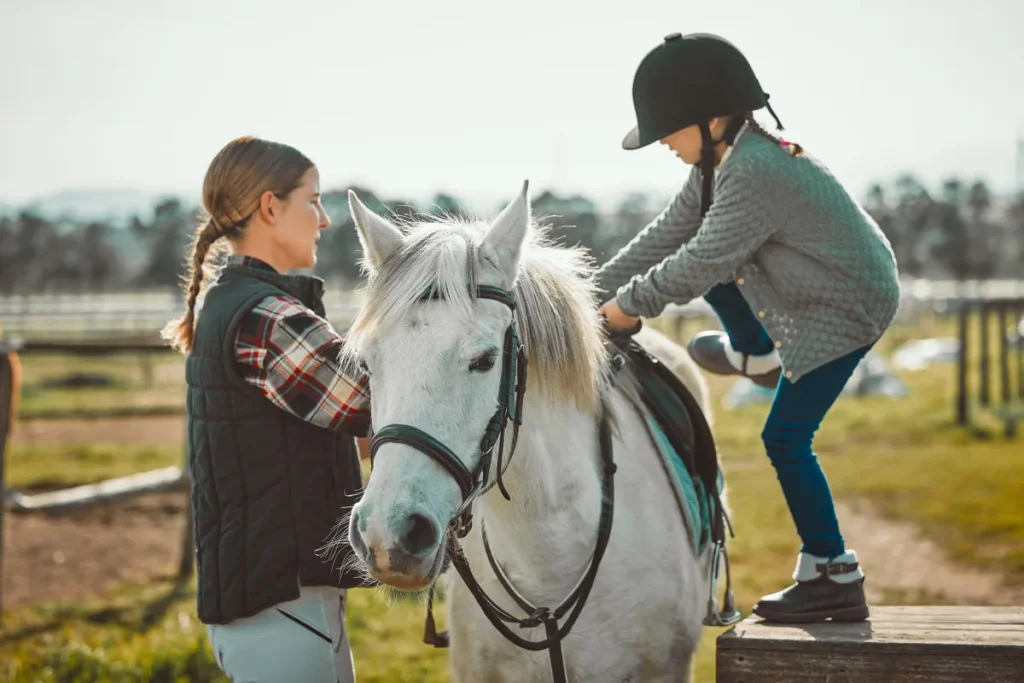
A good instructor will introduce the horse by name, explain a bit about its personality, and show your child how to pet the shoulder safely. Mounting usually happens at a mounting block — a small set of steps next to the horse — with an adult holding the reins. The first few minutes in the saddle are usually a slow walk while the instructor adjusts stirrups and checks position.
For pony rides, an adult typically leads the pony on a rope while your child sits in the saddle. The ride may last only five to ten minutes. For a beginner lesson, expect 30 minutes to an hour, mostly at a walk. No one is going to canter or jump on day one. Your child will learn to sit tall, hold the reins gently, and steer. Many kids finish their first session with a big grin and ask when they can come back. Some don’t, and that’s okay too.
Special Safety Tips for Younger Children
For toddlers and preschoolers, the focus shifts from “learning to ride” to “having a good first experience.” A few things help:
- Choose hand-led pony rides for kids or short lead-line sessions instead of independent riding.
- Look for providers who specifically work with young children and have small, calm ponies.
- Keep first sessions short. Five to ten minutes is plenty for many young kids.
- Stay close. Many providers welcome a parent walking right next to the pony.
- Introduce the horse slowly. Let your child watch, listen, and pet a shoulder before being lifted into a saddle.
- Don’t push a frightened child. If they say “no,” that’s the lesson for the day. There’s always next time.
Safety Tips for Family Trail Rides
If your family is planning trail rides with kids, a few habits make a big difference:
- Pick a beginner-friendly guided ride, not a fast or advanced one.
- Ask about the trail’s terrain and length. Steep, rocky, or river-crossing trails are tougher than flat wooded paths.
- Check the weather. Heat, lightning, or muddy conditions can change a “fun ride” into a hard one. Many operators cancel or reschedule for safety.
- Bring water for everyone, including yourself.
- Keep proper spacing between horses, usually about a horse-length, as your wrangler instructs. Penn State Extension’s trail safety guidance stresses riding at the pace of the least experienced rider in the group.
- Stay on marked trails. Don’t let kids urge their horse off the path.
- Confirm age, height, and weight rules before you book. They vary a lot.
Questions Parents Should Ask Before Booking
A short phone call before booking can answer almost every concern.
Safety and helmet questions
- Are helmets required, and do you provide them?
- Will staff fit my child’s helmet properly?
- What safety training and certifications do your instructors hold? (Many list CHA or PATH certification.)
- What’s your bad-weather policy?
- Are waivers required, and what do they cover?
Horse and ride questions
- What’s the minimum age for your rides or lessons?
- Do you offer pony rides, lead-line rides, lessons, or trail rides for kids?
- How do you match horses to a child’s size and experience?
- Are rides fully guided?
- Are total beginners welcome?
- What happens if my child gets scared mid-ride?
Logistics questions
- Are there height or weight requirements?
- What’s the instructor-to-child ratio?
- Can parents watch from the arena or trailhead?
- What should kids wear?
- How long is the ride or lesson?
A reputable provider will answer all of these without hesitation.
Red Flags When Choosing a Riding Stable
Sometimes the answers tell you more than the marketing. Be cautious if you notice:
- No clear helmet policy or pressure to skip helmets.
- Vague or inconsistent age and weight rules.
- Poor communication or rushed responses.
- Tack that looks frayed, cracked, or held together by tape.
- Horses that look thin, lame, or stressed.
- Overcrowded rides with one wrangler and many kids.
- No real instruction before kids mount up.
- Pressure to book right now without answering questions.
- A barn that looks chaotic, dirty, or unsafe.
Trust your gut. If something feels off, look elsewhere. Searching “horseback riding near me for kids” or “trail rides near me” usually returns several options, and a directory like LocalHorsebackRiding.com can help you compare them.
A Word About Insurance and Waivers
Most riding stables require parents to sign a waiver before a child can ride. These are standard for the industry and typically acknowledge the inherent risks of horseback riding. Read the waiver carefully so you know what you’re agreeing to.
It’s also worth knowing that most stables’ liability insurance does not pay medical bills for riders who get hurt. Your child’s health insurance is what handles medical care after a riding accident. If you’re unsure about your coverage, a quick call to your insurer before the first ride is a smart pre-ride step. Some families also ask the stable about their insurance policy and whether they’re a member of an organization like the Certified Horsemanship Association, which often requires member stables to maintain coverage.
Benefits of Horseback Riding for Kids
When the safety basics are in place, horseback riding for kids can be genuinely good for them.
Children who spend time around horses often build real confidence — there’s something powerful about learning to handle an animal that weighs ten times what you do. They also tend to develop a sense of responsibility, especially when they help groom and tack up before a lesson. Horses don’t respond to rushing or impatience, so kids quickly learn to slow down, breathe, and try again. That kind of patience is hard to teach in a classroom.
Riding also builds coordination and balance, gets kids outside and away from screens, and creates time for family bonding when parents and siblings ride together. Many young riders develop a deep respect for animals along the way, plus the simple, valuable habit of listening to a coach and following instructions.
We won’t oversell the benefits. Some claims about therapeutic or medical results require more research. What we can say is that many families find riding to be a meaningful, healthy activity when it’s done with care.
What Does Horseback Riding Cost for Kids?
Cost varies as much as everything else in this article, but here are common starting points to set expectations.
Hand-led pony rides at fairs, ranches, and family events often run about $10–$30 for a short ride. Group beginner lessons at a local stable typically range from $30–$75 per session. Private lessons usually cost $50–$150 per hour, with prices climbing higher in major metro areas or at established show barns. Guided beginner trail rides often run $50–$120 per person for a one- to two-hour ride, depending on location and operator.
Many stables offer lesson packages, punch cards, or memberships that lower the per-session cost. Summer riding day camps usually run $300–$700 per week and can be a more affordable, immersive way to introduce a child to riding.
Confirm pricing directly with your local provider before booking. Weekends, holidays, and sunset trail rides often cost more than weekday rides.
How to Find Horseback Riding for Kids Near You
If you’re searching for “horseback riding lessons near me” or “trail rides near me,” start local. Look for stables, ranches, equestrian centers, and family-friendly horseback riding operators in your state or city. Read reviews. Call ahead. Ask the questions above.
LocalHorsebackRiding.com is built to make that search easier. You can browse horseback riding lessons, trail rides, ranches, stables, and equestrian centers by state or city, compare options, and find providers that welcome kids and beginners. It’s a helpful starting point when you’d rather see your local options in one place than dig through ten different search tabs.
Final Safety Checklist for Parents
Before booking
– Confirm the minimum age for the ride or lesson.
– Ask about helmet requirements and whether helmets are provided and properly fitted.
– Ask about beginner-friendly options.
– Ask about trail difficulty if it’s a trail ride.
– Confirm clothing requirements.
– Ask about instructor or wrangler supervision.
– Confirm any height and weight rules.
– Read recent reviews from other parents.
– Check the cancellation and weather policy.
– Review the waiver and confirm your child’s health insurance coverage.
Before arrival
– Dress your child in long pants, closed-toe shoes with a small heel, and weather-appropriate layers.
– Tie back long hair.
– Arrive 15–30 minutes early so there’s time to fit a helmet and meet the staff.
– Bring water.
– Talk briefly with your child about staying calm around horses.
– Listen to all staff instructions, even the ones aimed at the kids.
– Don’t let children run around the barn or near the horses.
Horseback riding has inherent risks. Age limits, safety rules, helmet policies, height and weight requirements, and riding requirements vary by provider. Parents should always contact the riding stable, instructor, ranch, or trail ride operator directly before booking and should follow all posted safety rules and instructor guidance.
Conclusion
Horseback riding for kids can be one of those rare experiences that’s both adventurous and grounding. With the right provider, the right helmet, and a child who’s truly ready, it can spark a lifelong love of horses and the outdoors. The keys are simple: confirm age and safety rules with the local stable, use proper safety gear, and follow the instructor’s lead. Take the time to ask questions, watch your child closely, and let them set the pace. That’s how good first rides — and good memories — get made.
Frequently Asked Questions
These quick answers cover the most common questions parents ask about horseback riding for kids.
1. What age can kids start horseback riding?
There’s no universal age. Some hand-led pony rides for kids accept children as young as 2 or 3, while many formal lessons start around ages 5–7 and many guided trail rides start at 6, 7, or 8. Age requirements vary by provider, horse, insurance, and the child’s maturity. Always confirm with the local stable.
2. Is horseback riding safe for children?
Horseback riding has inherent risks and is not completely safe. The American Academy of Pediatrics notes that inexperienced riders are at greater risk of injury. Risks can be reduced with helmets, calm horses, trained supervision, and reputable providers.
3. Do kids need helmets for horseback riding?
Yes. The AAP, the Certified Horsemanship Association, US Pony Clubs, and the USEF (rule GR801) all support helmet use, with ASTM F1163 / SEI-certified equestrian helmets recommended. Many stables require them for minors.
4. Are pony rides safer than trail rides?
Not automatically. Pony rides are usually short and hand-led, but safety depends on the provider, the pony, the setting, and supervision. A well-run guided trail ride with calm horses can also be safe for kids who meet the age and skill requirements.
5. What should kids wear horseback riding?
A properly fitted equestrian helmet, long pants, and closed-toe shoes or boots with a small heel. Skip sandals, flip-flops, scarves, and dangling jewelry. Tie back long hair.
6. Can toddlers ride horses?
Some providers offer hand-led pony rides for children around age 2 or 3 if they can sit up unassisted. Most riding stables don’t offer formal lessons to toddlers. Always check directly with the provider.
7. Are horseback riding lessons better than trail rides for kids?
Lessons usually teach basic skills in a controlled arena, which is helpful for true beginners. Guided trail rides can be a fun family activity once a child meets the operator’s rules. Neither is universally better — it depends on the child and the provider.
8. How do I find horseback riding near me for kids?
Search local stables, ranches, and equestrian centers, read reviews, and ask the safety questions in this article. LocalHorsebackRiding.com lets you compare local horseback riding lessons, trail rides, and family-friendly options by state or city.
9. What questions should I ask a stable before booking?
Ask about minimum age, helmet rules, beginner options, instructor experience, horse-matching, ride length, weight and height rules, supervision, weather policy, and what happens if a child gets scared.
10. Do horseback riding places have weight or height limits for kids?
Often, yes. Many providers publish weight limits and minimum heights, though the specific numbers vary widely by stable, by horse, and by activity. Confirm before booking.
11. Are trail rides safe for beginner kids?
They can be, when the operator runs beginner-friendly rides, uses calm horses, requires helmets, follows weather rules, and matches kids to appropriate horses. Trail rides on steep or rough terrain are usually not for first-time child riders.
12. What is the best first horseback riding experience for a child?
For very young children, a short hand-led pony ride is often a good start. For older kids, a beginner arena lesson with a certified instructor (such as one credentialed by the Certified Horsemanship Association) is usually a great introduction.
13. How much do horseback riding lessons cost for kids?
Costs vary by region and stable. Hand-led pony rides often run $10–$30. Group lessons typically range $30–$75 per session and private lessons usually run $50–$150 per hour. Guided beginner trail rides often cost $50–$120 per person. Summer day camps usually run $300–$700 per week. Always confirm pricing with your local provider.